
OpsPilot AI
Intelligent operational orchestration for modern IT and digital environments, enabling faster incident response, reduced alert fatigue, and scalable operations with human-in-the-loop control.
Why OpsPilot AI Matters
Modern operational environments span hybrid infrastructure, multiple tools, distributed teams, and always-on services. Operations teams are overwhelmed by alert noise, fragmented workflows, and manual coordination across systems.
Traditional monitoring and automation tools surface problems but still rely heavily on human judgment to decide what actions to take and how to coordinate responses—leading to slower resolution times and inconsistent handling.
OpsPilot AI introduces intelligent operational orchestration by autonomously analysing signals and coordinating response workflows, while preserving human oversight at critical decision points. This reduces operational overhead, shortens incident resolution times, and enables teams to scale without increasing risk or headcount.
OpsPilot AI Workflow
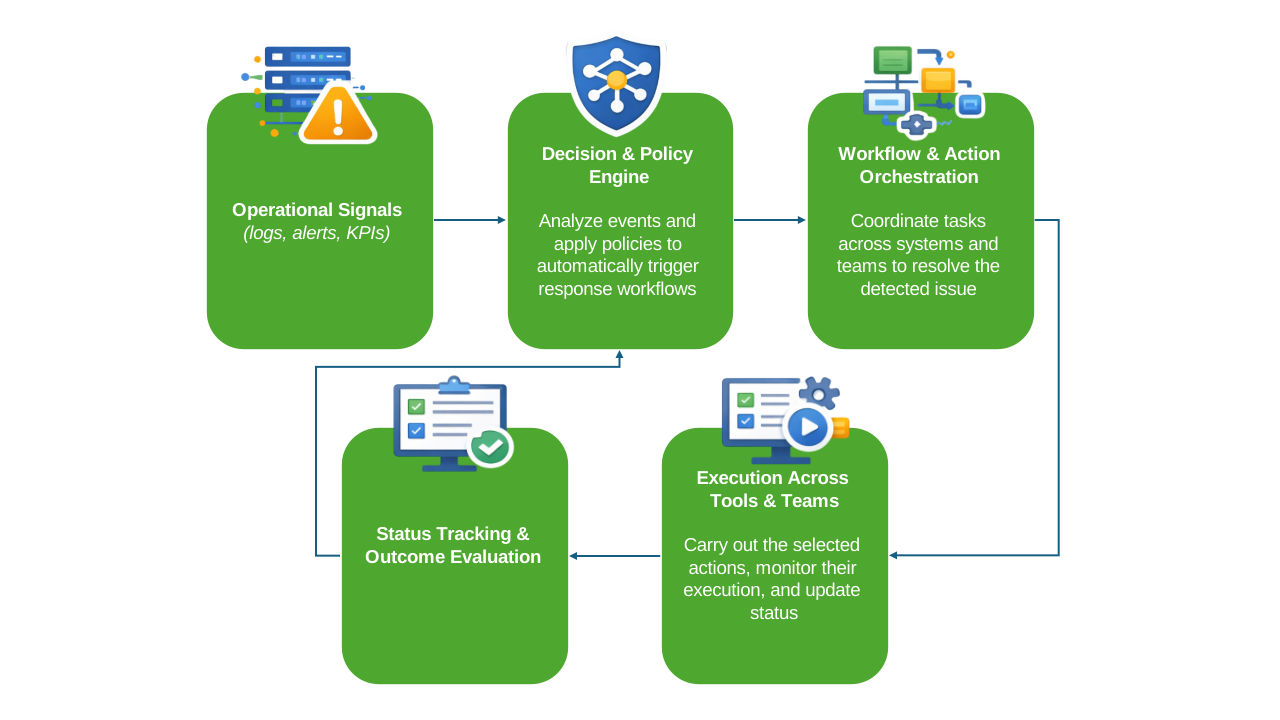
OpsPilot AI continuously ingests operational signals including logs, alerts, metrics, and KPIs from monitoring platforms, infrastructure tools, and business systems. These signals are normalised and correlated to detect meaningful events and anomalies.
Rather than reacting to individual alerts, the system evaluates context, severity, historical patterns, and policy constraints to determine when action is required and what response is appropriate.
Once an actionable event is identified, OpsPilot AI applies a policy-driven decision engine to select and orchestrate the response workflow across automated systems and human operators, with execution tracked end-to-end.
Operational Architecture & Control Plane
OpsPilot AI is built on a modular, event-driven architecture designed for reliability, scalability, and governance in complex operational environments. Lightweight connectors integrate with existing monitoring tools, logs, and infrastructure platforms to ingest real-time operational signals.
A correlation and normalisation layer aggregates signals into structured operational events, providing a unified view across hybrid and multi-cloud systems. At the core, an agent-based decision and policy engine evaluates events against organisational rules, risk thresholds, and operational context.
A workflow orchestration layer coordinates actions across APIs, automation tools, and human checkpoints, while a tracking and feedback layer monitors execution outcomes. This enables controlled, auditable automation with continuous improvement—without compromising safety or compliance.
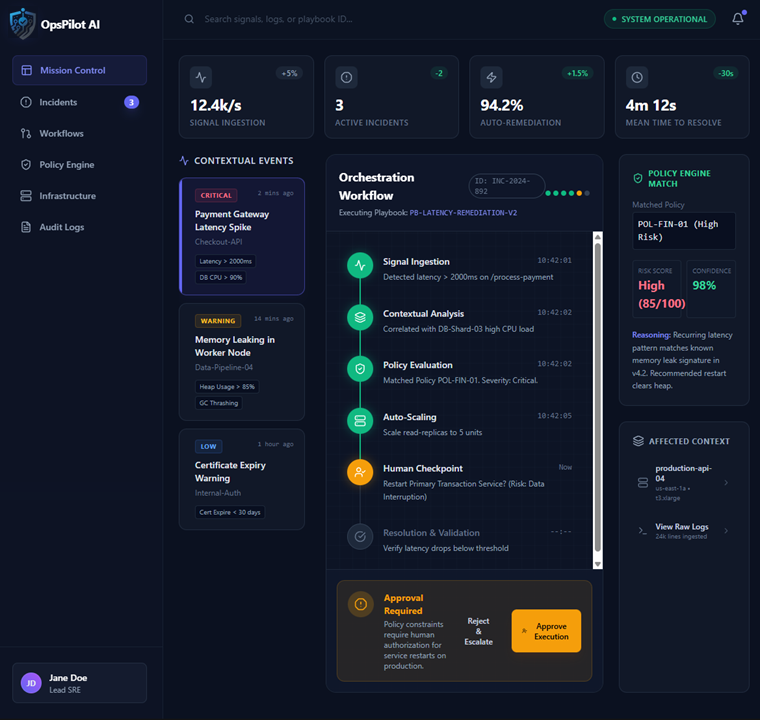
Deploy OpsPilot AI
OpsPilot AI is designed for enterprises operating complex digital environments, including cloud-native platforms, financial services, SaaS providers, and large-scale IT operations. Deploy incrementally and scale orchestration with governance and human oversight.